Table of Contents
NextUp TextAloud: Complete Guide
NextUp TextAloud is a Windows text-to-speech application that converts written content into spoken audio. It can read documents, webpages, PDF files, emails, and other text aloud through a computer, while also allowing users to save spoken content as audio files for later listening. The software is developed by NextUp and is designed for productivity, reading assistance, proofreading, accessibility, and people who prefer listening to written information rather than reading everything on screen. (nextup.com)
TextAloud is particularly relevant to people searching for the best text-to-speech software for Windows, a free text-to-speech program for PC, or software that can turn long documents into audio. It also has features aimed at struggling readers and people with dyslexia or low vision, including word highlighting while text is spoken
At the same time, many searches around TextAloud use terms such as speech-to-text, dictation, Windows speech recognition, and voice typing. These are related technologies but they work in the opposite direction. Text-to-speech converts written text into spoken audio, while speech-to-text converts spoken words into written text. Understanding this difference is important when choosing software.
This guide explains what NextUp TextAloud does, how it works on Windows, its voices and audio features, its free trial, document support, accessibility functions, and how it compares conceptually with built-in Windows speech tools and other text-to-speech or speech-to-text solutions.
What Is NextUp TextAloud?
NextUp TextAloud is text-to-speech software for Windows that reads digital text aloud using synthesized voices. According to NextUp, TextAloud 4 can convert text from documents, webpages, PDF files, and other sources into speech that users can listen to on a PC or save as audio files. (nextup.com)
The software is intended to make written information easier to consume. Instead of sitting in front of a screen and reading an entire article, report, email, or document, users can allow TextAloud to read the content aloud.
This can be useful in several situations. A student may listen to study material while reviewing the text. A writer can listen to an article to identify awkward sentences or errors. Someone with reading difficulties can use spoken audio and word highlighting to support comprehension. A person who spends a lot of time working on a computer can also listen to documents while performing other tasks.
TextAloud is therefore more than a simple voice generator. Its features are built around the practical use of text-to-speech on a Windows computer.
How Does NextUp TextAloud Work?
The basic concept behind TextAloud is simple. You provide written content, select a voice, and ask the program to speak the text.
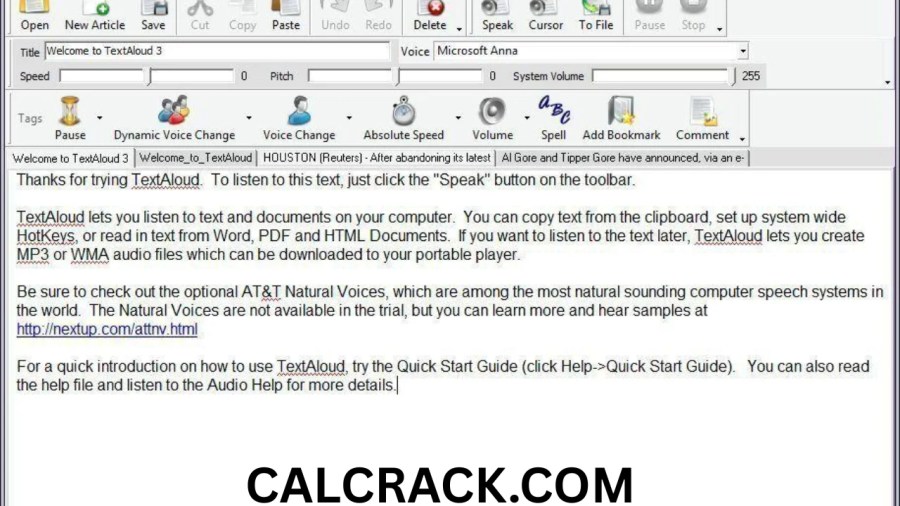
The application can receive content from several sources, including documents, webpages, copied text, and supported file formats. Users can also type or paste text directly into the application. The official TextAloud documentation describes options such as clipboard input, document importing, drag-and-drop, and hotkeys. (nextup.com)
Once the text is available, the user can start playback using the speaking controls. TextAloud then sends the text through a text-to-speech engine and produces spoken output through the computer’s audio system.
The software can also save spoken content to audio files. This means a long article does not necessarily have to remain inside TextAloud. Users can create an audio version that can be listened to later on another supported device or media player. (nextup.com)
What Is Text-to-Speech?
Text-to-speech, commonly abbreviated as TTS, is technology that converts written language into spoken audio.
For example, if a document contains the sentence “The weather is changing today,” a TTS application processes the written sentence and produces synthesized speech that sounds like someone reading those words.
Text-to-speech is useful for accessibility, productivity, education, proofreading, and hands-free consumption of written information.
NextUp TextAloud is specifically designed around this technology. It is intended to read text from different sources rather than requiring the user to manually record their own voice.
Modern TTS systems can use different voices, languages, accents, speaking speeds, and pronunciation settings. TextAloud supports multiple voice engines and optional premium voices, allowing users to choose voices that fit their preferences. (nextup.com)
Text-to-Speech vs Speech-to-Text
One of the most important distinctions when researching TextAloud is the difference between text-to-speech and speech-to-text.
Text-to-speech starts with written words and produces spoken audio.
Speech-to-text starts with spoken words and produces written text.
For example, if you paste an article into TextAloud and press Speak, that is text-to-speech.
If you talk into a microphone and Windows writes your spoken words into a document, that is speech-to-text or voice dictation.
These technologies can both be useful, but they solve different problems. TextAloud belongs primarily to the text-to-speech category.
NextUp TextAloud for Windows
NextUp TextAloud is designed specifically for Windows PCs. The official product page lists Windows versions including Windows 10 and Windows 11 among its supported operating systems. (nextup.com)
The Windows focus is useful for people who spend most of their working or studying time on a desktop or laptop.
Instead of depending on a browser-based TTS service, TextAloud operates as a Windows application and can work with content from different applications. Its floating toolbar can speak selected text from other windows, while integrations are available for Microsoft Word and Chrome. (nextup.com)
This makes it possible to use text-to-speech without constantly copying every paragraph into a separate website.
NextUp TextAloud Features
TextAloud includes a range of features designed around reading and listening.
Its main functionality includes converting written text into spoken audio, reading webpages and documents, saving speech as audio files, working with different voices, highlighting words while reading, and integrating with selected applications. (nextup.com)
Another useful function is the ability to create audio from longer reading material. The application includes a file splitter and batch file conversion features, which can help users process larger amounts of content. (nextup.com)
TextAloud 4 also introduced or improved functions such as configurable speaking controls, automatic continuation between articles, pronunciation dictionary improvements, a redesigned floating toolbar, and additional document and audio support. (mail.nextup.com)
Can TextAloud Read PDF Files?
Yes. TextAloud supports PDF files as one of the document sources it can process.
The official NextUp website states that TextAloud 4 converts text from PDF files, webpages, documents, and other sources into spoken audio. (nextup.com)
This can be particularly useful for students, researchers, employees, and anyone who regularly works with lengthy PDF documents.
However, there is an important distinction between a PDF containing selectable text and a PDF consisting primarily of scanned images. Text-to-speech software generally needs access to actual text. If a PDF is simply a collection of scanned page images, optical character recognition may be required before the text can be processed effectively.
Therefore, PDF support does not necessarily mean that every scanned document will immediately work as expected.
Can TextAloud Read Webpages?
Yes. Reading webpages is one of TextAloud’s intended uses.
The software can convert text from webpages into speech, and NextUp provides a Chrome extension as part of its integration features. It also has a floating toolbar that can speak selected text from different Windows applications. (nextup.com)
This can be useful when reading lengthy online articles, research material, instructions, news pages, or other text-heavy websites.
Instead of manually copying an entire page into another application, supported integrations can make the reading process more convenient.
For people who spend several hours each day reading online, listening to some content can also reduce the amount of time they need to continuously focus on a screen.
Can TextAloud Create MP3 Audio Files?
Yes. TextAloud can save spoken text as audio files.
NextUp’s documentation states that TextAloud can create MP3 and WAV files, while other TextAloud documentation also lists WMA support. The current TextAloud 4 feature documentation additionally describes support for Ogg/Vorbis audio output. (nextup.com)
This feature changes TextAloud from a simple reading application into an audio-generation tool.
For example, a user could convert an article into an audio file and listen to it later. A student could turn study notes into spoken material, while a writer could create an audio copy of a document for proofreading.
The software also includes file-splitting functionality, which can be useful when a large document needs to be separated into smaller audio sections. (nextup.com)
Does TextAloud Have Natural-Sounding Voices?
TextAloud supports multiple text-to-speech voices, including optional premium voices from different voice providers.
NextUp says its premium voice options include voices from providers such as Acapela, Ivona, Cerence, and ReadSpeaker, with multiple languages and accents available. The company states that more than 29 languages and many accents are offered through its voice selection. (nextup.com)
The quality of synthesized speech can depend on the particular voice engine and voice selected.
Users who prefer more natural-sounding speech can explore premium voices rather than relying only on the resident Windows voice.
The standard installation can use the Windows voice installed on the PC, while additional voices can be purchased separately. NextUp’s product page specifically explains that the trial uses the resident Windows voice and that premium voices are optional. (nextup.com)
Is NextUp TextAloud Free?
NextUp TextAloud is not a permanently free application, but NextUp provides a free trial.
The official download page currently lists TextAloud 4 as a free trial download, allowing users to test the software before purchasing it. (nextup.com)
The product page also identifies TextAloud as a paid application and lists a purchase price starting from $34.95. Pricing can change, so users should check the current product information before purchasing. (nextup.com)
The distinction between free download and free software is important. You can download and test TextAloud without paying immediately, but the trial should not be confused with permanent free access.
What Does the TextAloud Free Trial Include?
The TextAloud trial allows users to test the program’s text-to-speech functionality before purchasing.
According to NextUp, the trial uses the Windows voice already available on the user’s PC. The purchased version can also use the resident Windows voice if additional premium voices are not installed.
This gives users an opportunity to determine whether the application fits their workflow before purchasing additional voices or the full program.
For someone primarily interested in basic TTS, the trial can also demonstrate how TextAloud handles documents, webpages, playback controls, and audio output.
Is TextAloud Good for Students?
TextAloud can be useful for students who need to process large amounts of written material.
A student can use it to listen to documents, study material, research papers, or other supported text. Listening can provide an alternative way of consuming information when continuous screen reading becomes tiring.
NextUp specifically describes TextAloud as useful for students and people who struggle with reading, and its accessibility material explains how simultaneous reading and listening can support fluency and comprehension.
The word-highlighting feature can also help connect spoken words with their written forms. Users can adjust text appearance and speaking speed to suit their preferred reading pace.The effectiveness of these features naturally varies from person to person, but the design is clearly intended to support this type of use.
TextAloud for Dyslexia and Accessibility
Accessibility is one of the areas where TextAloud has a particularly clear use case.
NextUp describes TextAloud as assistive technology for people with dyslexia, low vision, ADD, and other reading difficulties. The software can highlight text while it is being spoken, allowing users to follow the written words while hearing them.
Users can also change font size, font settings, background appearance, and reading speed.
These controls can make long reading sessions easier for people who have difficulty maintaining visual concentration.
TextAloud should not be considered a medical treatment, but it can function as an accessibility and assistive-reading tool for people who find listening helpful.
Can TextAloud Be Used for Proofreading?
Yes. Proofreading is another practical use for TextAloud.
When people read their own writing silently, the brain can sometimes interpret what was intended rather than what is actually written. Listening to the same text can provide a different way of noticing awkward wording, missing words, repeated phrases, or sentences that do not sound natural.
NextUp specifically promotes TextAloud for proofreading documents, reports, and emails. This can be useful for students, writers, business users, and anyone who regularly produces written content.
A text-to-speech application does not replace a grammar checker or human editor, but it can provide another layer of review.
Can TextAloud Help With English Learning?
TextAloud can also be used as a language-learning aid.
Listening to written English while following the words on screen can help learners connect spelling and pronunciation. The ability to change speaking speed can also allow users to begin with slower speech and gradually increase the pace.
NextUp’s documentation specifically mentions TextAloud as a tool that can be used for learning English and notes support for multiple languages and natural-sounding voices.
The usefulness depends on the learner’s level and goals, but the combination of written text and synthesized speech can be helpful for pronunciation exposure and listening practice.
What Documents Does TextAloud Support?
TextAloud supports a variety of document formats and input methods.
The official documentation lists Microsoft Word, Rich Text, WordPerfect, OpenOffice, PDF, HTML, and XML among supported document types. It also supports importing text through the clipboard, drag-and-drop, and other input methods.TextAloud 4 expanded its document support further, including FictionBook format according to the product’s release information.
This broad document support is useful because users do not have to manually retype content before listening to it.
TextAloud Floating Toolbar
The floating toolbar is one of TextAloud’s useful features for people who work across multiple Windows applications.
NextUp explains that the floating toolbar can speak selected text from any window or import selected text into TextAloud.
This means that a user can potentially select text in another application and send it to TextAloud without constantly switching between programs.
For example, someone working on a document could select a paragraph and have it read aloud for proofreading.
This type of integration is particularly useful for people who use TTS throughout their normal computer workflow rather than only occasionally.
TextAloud and Microsoft Word
TextAloud provides integration with Microsoft Word.
The software can work with Word documents and provides a toolbar or extension-based workflow for supported Microsoft applications.
This is useful for writers and students because they can listen to their writing without necessarily converting the document into another format first.
Hearing a report, essay, email, or article read aloud can make it easier to identify places where the wording does not sound natural.
What Is the Difference Between TextAloud and Windows Narrator?
Windows Narrator and TextAloud both involve spoken computer content, but they are designed with somewhat different purposes.
Windows Narrator is a built-in Windows accessibility feature designed to help users interact with and navigate the operating system through spoken feedback.
TextAloud is a dedicated text-to-speech application focused on reading documents, webpages, articles, and other written material and creating audio files.
Therefore, someone looking for a full screen reader may be evaluating a different category of software than someone looking for an application that turns documents into listenable audio.
TextAloud’s ability to create audio files and work with longer documents is one of the features that distinguishes its workflow.
What Is the Best Free Text-to-Speech Software for PC?
There is no single free TTS program that is objectively the best for every Windows user.
For someone who only needs basic text-to-speech, Windows already provides speech-related accessibility features and installed voices. For someone who wants a dedicated application for reading documents, creating audio files, managing articles, and using additional voices, a dedicated application such as TextAloud provides a broader workflow.
TextAloud itself is not permanently free, but it offers a free trial that lets users test the software.
Other free TTS options are also available through operating-system features, web applications, and open-source or community-developed tools. The appropriate choice depends on voice quality, supported formats, offline availability, accessibility requirements, and whether audio-file creation is important.
What Are the Best Free Text-to-Speech Programs?
Free TTS programs can be divided into several categories.
Some are built directly into operating systems. Others are browser-based tools, dedicated desktop applications, or open-source projects.
When comparing them, users should look beyond voice quality. Important factors include the number of voices, supported languages, ability to change speaking speed, document support, offline operation, accessibility features, and whether the program can export speech to audio files.
TextAloud is useful as a reference point because it combines several of these functions in one Windows application, although its full version is paid after the trial period.
Is ChatGPT Text-to-Speech Free?
ChatGPT provides voice functionality that allows users to speak with ChatGPT and hear spoken responses. OpenAI describes ChatGPT Voice as a natural voice conversation feature within ChatGPT, while dictation is used when a user wants a recording converted into editable text.
This is related to text-to-speech but is not exactly the same workflow as a dedicated Windows application such as TextAloud.
TextAloud is designed specifically to process written material from documents, webpages, and other sources, while ChatGPT Voice is designed around conversational interaction with an AI assistant.
Availability and usage limits can depend on the ChatGPT account and product configuration, so users should check the current ChatGPT experience rather than assuming that every voice feature has unlimited free use.
Is There Free Speech-to-Text Software for Windows 11?
Yes. Windows 11 includes built-in voice features that allow users to use their voice to control the computer and author text.
Microsoft explains that Voice Access in Windows 11 allows users to control their PC and author text using their voice. Microsoft also states that Voice Access uses modern on-device speech recognition and can work without an internet connection.
This is important because speech-to-text is the reverse of TextAloud.
If you want to speak into a microphone and have Windows type your words, you need speech recognition or voice dictation rather than TextAloud.
Where Can I Download Speech-to-Text Software?
Windows 11 users can use the built-in Voice Access feature for speech-based computer control and text authoring.
Microsoft’s current documentation explains that Voice Access can be used to author text using voice and control Windows without relying entirely on a keyboard or mouse.Other speech-to-text software is also available from software developers and cloud providers. Google, for example, provides a Speech-to-Text service that processes audio and returns transcriptions. Its current pricing documentation describes a free monthly allowance for certain Speech-to-Text usage before charges apply.
For ordinary Windows users, however, built-in Windows voice features may be sufficient for basic dictation without installing a separate desktop application.
What Is the Best Text-to-Speech Software for Windows?
The best option depends on what the user expects from text-to-speech.
A basic user may want a simple way to hear selected text. A student may need document and PDF support. A writer may prioritize proofreading. Someone with accessibility needs may need word highlighting, adjustable fonts, and speed controls. Another user may want to turn articles into MP3 files.
TextAloud addresses many of these requirements in one application. It can read documents and webpages, work with multiple voices, highlight words, integrate with selected applications, and save spoken content as audio files.
That makes it a dedicated option for Windows users who want more than basic operating-system speech.
What Is the Best Free Software for Speech-to-Text?
For Windows 11 users, the built-in Voice Access functionality is one option for speech-based text entry. Microsoft states that Voice Access allows users to control Windows and author text using their voice.
The choice becomes different when users need transcription of recorded audio files, interviews, meetings, or other long recordings. Cloud speech-recognition services and specialized transcription applications can be more suitable for those workflows.
Google’s Speech-to-Text service, for example, is designed to process audio and generate transcriptions, with pricing based on the amount of audio processed and specific free usage depending on the service configuration.
Therefore, “best” depends on whether the requirement is live dictation, PC control, or recorded-audio transcription.
Is Microsoft Free Text-to-Speech Available?
Windows includes built-in speech technologies that can read text and provide spoken accessibility functions.
Microsoft’s Windows platform provides built-in voices and accessibility tools, while Windows 11 also includes Voice Access for the opposite direction of speech-to-text and voice control. Microsoft’s documentation distinguishes device-based speech recognition from online speech recognition.
This means users do not necessarily need to install a separate TTS application for basic spoken computer functions.
However, dedicated applications such as TextAloud can provide additional features focused specifically on reading documents, webpages, creating audio files, and managing long-form listening.
Does Windows 10 Have Speech-to-Text Software?
Yes. Windows 10 includes built-in speech recognition functionality.
Microsoft’s documentation explains that Windows supports speech recognition and provides instructions for setting up a microphone and configuring speech features.
Windows 10 users can therefore use built-in speech recognition for voice control and dictation without necessarily installing third-party software.
It is important to distinguish this from TextAloud. Windows speech recognition converts speech into text, while TextAloud converts text into speech.
Is Google Speech-to-Text Free?
Google provides Speech-to-Text with a free usage allowance for certain configurations, but it is not an unlimited free service.
Google’s current Speech-to-Text pricing documentation lists a free allowance for the first 60 minutes per month under specified standard recognition pricing, with charges applying after the applicable free usage.
The exact cost can depend on the model, recognition method, audio length, number of channels, and other factors.
This makes Google’s service different from a simple free Windows dictation feature. It is primarily a cloud speech-recognition service that can be integrated into applications and workflows.
How to Activate Text-to-Speech in Windows 11
Windows 11 provides built-in speech and accessibility functionality, although the exact steps depend on whether the user wants text-to-speech, speech-to-text, or the Narrator screen reader.
For spoken accessibility, users can open Windows Settings and navigate through the Accessibility options to find Narrator and related features.
If the goal is speech-to-text, Windows 11 uses Voice Access for modern voice control and text authoring. Microsoft explains that Voice Access can control the computer and author text using voice, and it can operate using on-device speech recognition.
For users specifically looking for a dedicated application that reads documents aloud and creates audio files, installing a TTS application such as TextAloud provides a different workflow.
NextUp TextAloud for Long Articles and Documents
One of TextAloud’s strongest practical use cases is long-form reading.
A person who needs to read dozens of pages can import supported material and listen rather than relying entirely on visual reading. The ability to save content as audio files also means the user can continue listening away from the computer.
This workflow can be useful for research papers, ebooks, articles, reports, emails, and study material.
The software’s article management and automatic continuation functions can also make longer listening sessions more convenient. TextAloud 4 introduced an Auto Continue feature that allows the application to continue to the next article when configured to do so.
NextUp TextAloud for Proofreading and Writing
Writers can use TextAloud as a listening-based proofreading tool.
After writing a document, hearing it read aloud can expose problems that may be easy to overlook while silently reading. Awkward sentences, repeated words, missing words, and unnatural phrasing can sometimes become more obvious when spoken.
NextUp specifically identifies proofreading as a use case for TextAloud and says that hearing written work read back can help users identify errors.
This makes TextAloud relevant not only to people who want accessibility support but also to people who create a lot of written content.
NextUp TextAloud System Requirements
NextUp’s current TextAloud product page lists Windows 10 and Windows 11 among its supported operating systems. The published requirements also include a 500 MHz CPU or faster, 256 MB of RAM, 1 GB of disk space, and a sound card. These requirements are relatively modest compared with modern Windows computers.
However, software requirements can change between releases, and users should check the current requirements for the exact TextAloud version they plan to install.
The official download page currently lists TextAloud 4.0.73 as a downloadable version and also references release information and pre-release versions.
Why Choose NextUp TextAloud?
NextUp TextAloud is primarily aimed at users who want a dedicated Windows environment for converting written material into speech.
Its combination of document support, browser integration, selectable text reading, word highlighting, multiple voices, proofreading functionality, and audio-file creation gives it a broader workflow than simply pressing a basic Windows accessibility button.
It can be particularly useful when reading is a regular part of someone’s daily computer activity.
The free trial also means users can test the application before deciding whether its features justify purchasing the full version.
Final Thoughts on NextUp TextAloud
NextUp TextAloud is a dedicated Windows text-to-speech application that converts written content into spoken audio. It supports documents, webpages, PDF files, multiple voice engines, word highlighting, browser and Word integration, proofreading, and audio-file creation.
Its main difference from speech-to-text software is the direction of conversion. TextAloud takes written content and produces speech, while Windows Voice Access and other speech-recognition systems take spoken words and produce text. Microsoft currently positions Voice Access as a Windows 11 feature for controlling the PC and authoring text with voice.
For users searching for the best text-to-speech software for Windows, TextAloud is worth considering when document reading, accessibility, proofreading, voice selection, and audio-file creation are important. It offers a free trial rather than permanent free access, allowing users to evaluate the software before purchasing. The best solution ultimately depends on the user’s specific purpose. Basic Windows features may be enough for occasional speech functions, while a dedicated application can be more suitable for people who regularly convert long documents and webpages into spoken audio.
Frequently Asked Questions
What is the best free text-to-speech software for PC?
There is no single free text-to-speech application that is best for every PC user because requirements differ. Windows already provides built-in speech and accessibility features, while dedicated programs can offer additional controls, document support, voices, and audio export. NextUp TextAloud is a dedicated Windows TTS application with a free trial, but its full version is paid rather than permanently free.
What are the best free text-to-speech programs?
Free text-to-speech programs are available in several forms, including built-in Windows features, browser-based services, and dedicated applications. When comparing them, users should consider voice quality, language support, speaking speed, document compatibility, accessibility features, offline operation, and audio export. TextAloud provides many of these features but operates as a paid application after its trial period.
Is ChatGPT text-to-speech free?
ChatGPT provides a Voice feature that lets users speak with ChatGPT and hear spoken responses. OpenAI describes Voice as a conversational feature inside ChatGPT rather than a traditional standalone Windows text-to-speech application. Availability and usage limits can depend on the current ChatGPT product and account configuration, so it should not automatically be treated as an unlimited free TTS service.
Is there a free speech-to-text software available for Windows 11?
Yes. Windows 11 includes Voice Access, which allows users to control the computer and author text using their voice. Microsoft states that Voice Access uses modern on-device speech recognition and can work without an internet connection. This makes it useful for users who want speech-to-text or voice control without immediately installing third-party software.
Where can I download speech-to-text software?
Windows 11 users can use the built-in Voice Access feature for speech-based computer control and text authoring. Other options include dedicated transcription applications and cloud speech-recognition services such as Google’s Speech-to-Text. The appropriate download or service depends on whether you need live dictation, PC voice control, or transcription of recorded audio.
What is the best text-to-speech software for Windows?
The best text-to-speech software depends on the user’s specific requirements. NextUp TextAloud is designed specifically for Windows and supports documents, webpages, PDF files, multiple voices, word highlighting, proofreading, browser integration, and audio-file creation. Users who need only basic spoken accessibility may find Windows’ built-in tools sufficient, while users who regularly listen to long documents may benefit from a dedicated TTS application.
What is the best free software for speech-to-text?
For basic speech-to-text and voice control on Windows 11, Microsoft’s built-in Voice Access is one available option. It allows users to author text and control the computer using voice. For recorded interviews, meetings, or longer audio files, specialized transcription tools and cloud services can provide additional functionality. The appropriate choice depends on whether the requirement is live dictation or recorded-audio transcription.
Is Microsoft free text-to-speech available?
Yes, Windows includes built-in speech and accessibility technologies that can provide spoken feedback and text-to-speech functionality. Microsoft also provides Windows speech features for voice recognition and accessibility. A dedicated program such as TextAloud offers a different workflow focused on reading documents, webpages, and other written material and creating audio files.
Does Windows 10 have speech-to-text software?
Yes. Windows 10 includes speech-recognition functionality that can be configured with a microphone for voice control and dictation. Microsoft provides setup instructions for Windows speech recognition. TextAloud is different because it primarily performs text-to-speech, meaning it reads written content aloud instead of turning spoken words into written text.
Is Google speech-to-text free?
Google Speech-to-Text provides a free allowance under certain pricing configurations, but it is not an unlimited free service. Google’s current pricing information lists a free allowance for specified usage before charges apply, with pricing based on the amount of audio processed and other factors.
How do I activate text-to-speech in Windows 11?
Windows 11 provides built-in speech and accessibility features through Settings, including Narrator for spoken accessibility. If your goal is to have Windows convert your spoken words into written text, Voice Access is the relevant modern feature; Microsoft explains that it can control Windows and author text using voice. If your goal is to read documents aloud and create audio files, a dedicated application such as NextUp TextAloud provides a more specialized text-to-speech workflow.
Download Now
NextUp TextAloud Latest Version
- File Size: 25.8 MB
- System Type: 32-bit / 64-bit
- Setup Type: Offline / Standalone